
Google Ads
Google Ads run
on net profit
Most accounts optimise toward ROAS in a dashboard. I optimise toward the number that is actually left once everything is paid.

What is Google Ads?
Google Ads is Google's advertising platform. This is where you pay to appear when someone searches for what you sell, or as they move around YouTube, Gmail and the rest of Google's network. Where SEO is about earning visibility over time, Google Ads lets you buy visibility right away.
The system works as a continuous auction. Every time someone searches, Google decides in a split second which ads show and in what order. The price is set not only by what you bid, but also by your Quality Score, meaning how relevant and well built your ad and landing page are. Do the work well and you pay less for a better position.
The key terms along the way:
- CPC (cost per click), the price you pay each time someone clicks.
- CTR (click-through rate), the share of people who see the ad and go on to click.
- ROAS (return on ad spend), revenue per ad dollar. The number most people steer by.
- POAS (profit on ad spend), profit per ad dollar. The number I steer by, and one you can read more about in the article POAS explained.
Profit over ROAS
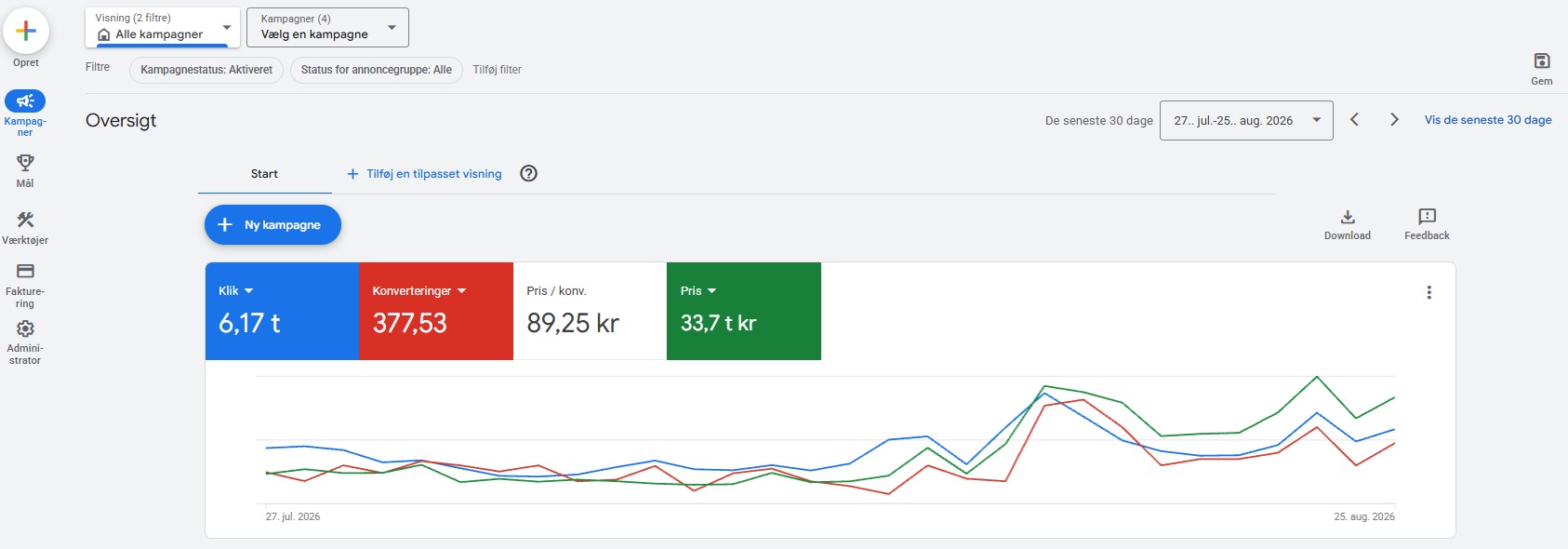
Return on ad spend has become the standard metric for Google Ads, but it is a deceptive number. A campaign can post a strong ROAS and still lose money once cost of goods, shipping, fees and returns are deducted. I steer by POAS, profit on ad spend, so we optimise toward what actually reaches the bottom line.
It sounds obvious, yet it changes everything. Suddenly the campaign that looked best is no longer the one that should get the most budget. Because I am a webshop CEO myself, I know the difference between revenue and profit in practice, not just in theory. If you are unsure whether to start with ads or organic visibility at all, read along in SEO or Google Ads.
How I work
I start by connecting real numbers to the account: cost of goods, margins and first-party data from the webshop. Without that you optimise blind, so solid business intelligence is the foundation under an account that steers by profit. From there it is about discipline, not about tweaking everything all the time.
- Real targets. POAS targets set to your actual margin, not a generic ROAS.
- Controlled scaling. We pour budget into what provably makes money and pull back on the rest.
- A steady rhythm. A morning check on the KPIs that genuinely tell you whether yesterday was good or poor, rather than reacting to noise.
And the work does not stop at the click. The best ad in the world is wasted if the landing page does not convert. That is why Google Ads is closely tied to conversion optimisation: getting more of those expensively acquired visitors to buy.
Campaign types that work
There is no universal recipe. Performance Max, Shopping, Search and Demand Gen each have their own strength, and the choice depends on your product range, your data and your goal. I test them against each other on real numbers rather than following whatever is trending in a LinkedIn post.
What matters most is that the structure stays transparent. You should be able to see where the money comes from and what drives the growth. A black box that hands you one combined number is hard to improve.
How it fits with SEO and the rest
Google Ads is strongest when it does not stand alone. Search-term data from the ads shows exactly what converts, and that knowledge makes my SEO work more precise. A strong organic presence lowers the cost of your clicks at the same time, and a well crafted brand lifts the click rate on everything. This is the omnichannel mindset I build all my work on.
FAQ
Google Ads, in brief
What is a good ROAS?
Should I use Performance Max or regular Shopping?
How large a budget do I need?
Can Google Ads and SEO work together?
Articles on the topic
Alle artiklerGoogle Ads
Google Ads cost per click: what does a click cost?
There is no fixed price per click in Google Ads. Here is what drives the price, the rough levels to expect, and how to find your own cost per click.
Google Ads
POAS: How to Optimize for Profit Instead of ROAS
POAS measures profit from advertising after variable costs. Learn how it differs from ROAS and how to use it across paid channels.
Read more
The other playbooks
Profit Engineering
Metoden der binder disciplinerne sammen.
SEO
Visibility on Google and in AI answers, measured on revenue rather than clicks.



Paid Social
Meta and social advertising with creative and scaling you can measure.


Automation
Email, flows, and AI automation that drive repeat sales on autopilot.


Branding
A strong brand lowers the cost of every click and every email.


Omnichannel
SEO, ads, email, and branding coordinated so they reinforce each other.


Are you burning money on the wrong things?
Book a no-obligation 30-minute meeting and we will look at whether your Google Ads account steers by profit or just by ROAS.